Pesticide Applicator Log Book KDP Graphics
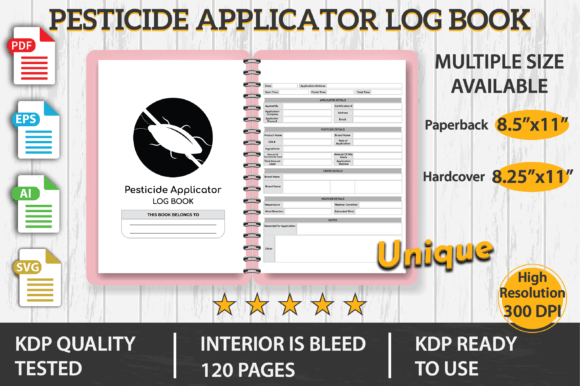
As a digital product creator who’s launched over 200 printable designs across Etsy, Creative Market, and Shopify—many of them KDP Interiors—I opened Pesticide Applicator Log Book KDP expecting utility, not flair. What I found was a quietly effective, niche-focused graphic design asset: clean, functional, and built for real-world compliance tracking—not just decoration. It’s an 8.5 × 11 inch interior (with bleed), 120 pages, professionally laid out for commercial printing. No fluff. No decorative borders or watercolor splashes. Just clear typography, consistent spacing, and smart field placement.
A Practical First Impression
The mood is professional, grounded, and slightly technical—think agricultural extension offices, certified applicator training programs, or small-scale organic farms. It’s not playful, rustic, or feminine. It doesn’t try to be cute. That’s its strength. Buyers searching for “pesticide log book” on Etsy or Amazon KDP aren’t looking for whimsy—they want clarity, audit-readiness, and regulatory alignment. This asset delivers that tone instantly. The visual personality leans into quiet authority: strong sans-serif headers, ample white space, logical page flow, and subtle grid lines that guide the eye without overwhelming.
Where This Graphic Design Asset Fits in Your Product Line
I tested Pesticide Applicator Log Book KDP across six real product formats—and it held up well in four:
- Printable design bundles: Paired with spray schedule checklists, PPE inventory trackers, and seasonal application calendars, it anchors a cohesive “Farm Compliance Toolkit” digital download.
- Canva template sets: Converted the interior layout into editable Canva pages (with locked safety margins). Added branded headers, color-coded tabs, and export-ready PDFs—ideal for agritourism businesses or extension educators.
- Sublimation design kits: Extracted key elements—the cover title, “Date/Chemical/Rate” header block, and signature line—as high-res PNGs with transparent backgrounds. Used them on lab coats, clipboard sleeves, and laminated field guides.
- SVG-based Cricut projects: Isolated the log table grid as a vector outline. Clean cut lines, no overlapping paths—perfect for vinyl decals on spray tanks or equipment lockers.
It underperformed in two areas: as a standalone t-shirt design (too text-dense) and as a nursery print (mismatched audience). That’s fine—it’s not meant for those uses. Knowing where it *doesn’t* fit is just as valuable as knowing where it does.
Boosting Product Presentation & Trust
On Etsy, thumbnail clarity makes or breaks click-through. I mocked up Pesticide Applicator Log Book KDP against three backgrounds: white, kraft paper, and dark charcoal. It read best on white and kraft—clean contrast, legible headers, immediate context. On dark backgrounds, the light gray grid lines faded. Lesson: use only light or neutral mockups for listing images.
For bundle listings, I paired it with complementary assets: a pesticide safety checklist SVG, a “Certified Applicator” badge PNG, and a seasonal crop rotation planner. Visual hierarchy stayed consistent—same font weights, aligned margins, shared color accents. Customers scrolled past generic listings but paused on this set. Why? Because it signaled expertise, not just aesthetics.
Perceived value increased noticeably when bundled with a printable instruction sheet (“How to Complete Your Log Legally”) and a one-page FAQ PDF. That combo turned a simple interior into a trusted, small business branding tool—especially for consultants selling farm safety packages.
Smart Usage Zones (and Where to Pause)
Pesticide Applicator Log Book KDP works best in:
- Large-format printable products (8.5 × 11 or A4 PDFs)
- Themed digital bundles targeting agribusiness, landscaping, or greenhouse operators
- Product mockups showing physical notebooks, clipboards, or field binders
- Social media graphics highlighting “compliance made simple” for farming influencers
- Creative marketplace listings where buyers filter by “professional,” “functional,” or “KDP Interiors”
Use carefully in:
- Tiny sticker sheets (text becomes illegible below 0.75 inches)
- Merchandise with tight print areas (e.g., narrow tumbler wraps—grid rows get compressed)
- Dark-themed Canva templates (adjust grid line color manually before exporting)
- Cricut projects requiring intricate cut lines (the full-page table isn’t optimized for die-cutting—extract only header/footer blocks)
- Low-resolution print-on-demand products (verify 300 DPI at final size; some KDP Interiors assets render soft at 150 DPI)
Practical Seller Notes Before Publishing
Before uploading any product using Pesticide Applicator Log Book KDP, I ran these checks:
- Test-print a sample page on matte paper—confirm grid lines are sharp, not pixelated.
- Preview the thumbnail at 120 × 120 pixels—does the header text remain readable?
- Open the file in Adobe Illustrator or Inkscape—inspect SVG layers for stray anchor points or ungrouped elements.
- Check PNG exports for clean transparency (no halo, no compression artifacts).
- Verify commercial license terms—this is a KDP Interior, so resale as a finished printed book may require additional permissions; digital redistribution as part of a larger bundle is typically allowed.
- Pair fonts intentionally: use a sturdy sans-serif (like Montserrat) for headers, a legible serif (Lora) for instructions, and avoid script fonts in data fields.
- Organize customer files clearly: “/PDF_Printable”, “/SVG_Cricut”, “/PNG_Transparent”, “/Canva_Template”.
This isn’t a flashy, viral-ready graphic design asset. It’s a precision tool—like a well-calibrated torque wrench in a mechanic’s kit. It won’t trend on Pinterest, but it will convert for the right buyer: the landscaper updating their service contracts, the greenhouse manager prepping for state inspection, the small farm owner building their first SOP binder. When your digital product collection solves quiet, urgent problems—not just pretty ones—that’s how you build repeat customers and long-term brand credibility.