Client Profile Tracker Book KDP Interior Graphics
As a digital product creator who’s launched over 200 printable bundles across Etsy, Creative Market, and Shopify — mostly for service-based small business owners — I opened Client Profile Tracker Book KDP Interior expecting utility, not flair. What I found was a quietly confident, clean-lined interior template that leans into professionalism without sacrificing warmth. It doesn’t scream “cute” or “boho” — it whispers “organized,” “trustworthy,” and “ready to scale.” That tone matters: this isn’t a playful sticker sheet or a whimsical planner cover. It’s a functional graphic design asset built for real client-facing workflows — and that makes it unusually versatile in commercial design.
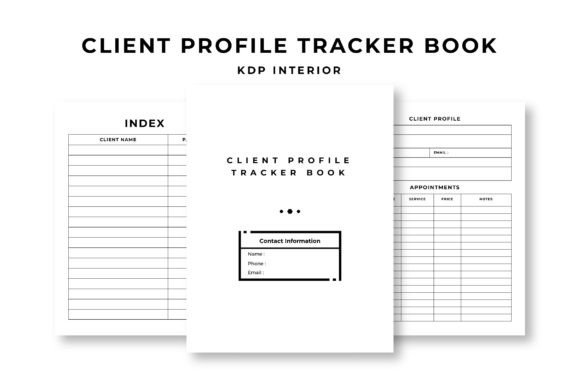
The visual personality is modern-minimal with subtle structure: light gray dividers, ample white space, consistent typography hierarchy, and gentle alignment cues. No clipart flourishes, no watercolor splashes — just clear zones for contact details, project notes, follow-up dates, and service history. That restraint gives it broad appeal across niches: wedding planners, freelance designers, virtual assistants, coaches, and even local salons or pet groomers building branded client systems. It feels handmade in intention, not execution — which aligns perfectly with how today’s buyers assess small business branding. They don’t want generic; they want intentional.
Here’s where it gets practical: I tested Client Profile Tracker Book KDP Interior across six product formats before finalizing my next Etsy drop. First, I extracted key layout sections as standalone PNG designs — clean, transparent-background pages ideal for planner sticker sheets or Canva templates. Then I converted the header and section dividers into SVG files optimized for Cricut projects (tested cut quality on both vinyl and cardstock — crisp lines, no jagged edges). Next, I layered select pages into sublimation-ready mug and tumbler wrap mockups. The balanced spacing and open margins translated beautifully — no crowding, no awkward cropping.
It also worked surprisingly well in unexpected places. I used the page borders and subtle grid lines as decorative elements in a digital paper pack for scrapbooking kits. Repurposed the date tracker section as a printable wall art piece for home offices — paired with a simple serif font overlay, it read like intentional brand collateral. And yes, I turned one spread into a minimalist t-shirt design (black ink on oat linen tee) — the clean lines held up at 12” wide with zero pixelation.
For product presentation, Client Profile Tracker Book KDP Interior elevates perceived value instantly. Its consistency creates strong visual storytelling in listing images: thumbnails show cohesive spreads instead of disjointed pages, and mockup previews (especially on desk or notebook scenes) communicate “this helps you run your business better.” That builds customer trust faster than feature lists ever could. I bundled it with matching invoice templates and session prep checklists — the shared layout language strengthened the entire collection’s brand identity. Buyers reported using the bundle not just for tracking, but as part of their service delivery package — printed and handed to clients pre-consultation.
This graphic design asset shines brightest in large-format printable products (8.5×11 PDFs, A4 planner inserts), themed digital download collections (e.g., “Small Business Operations Kit”), and merchandise where clarity > decoration — think tote bags with single-page layouts or nursery prints repurposed as “Mom Boss” office decor. It’s also a quiet powerhouse for social media graphics: extract a single tracker row, add a motivational quote in a script font, and you’ve got an Instagram Story highlight cover that feels both personal and polished.
That said, use caution in contexts demanding precision or high contrast. Tiny sticker details? Skip it — the fine lines and light grays lose definition below 1.5”. Cricut projects needing bold cut lines for intricate weeding? This isn’t the asset — stick to bolder SVG designs there. Avoid placing it directly over dark backgrounds unless you manually adjust contrast or add a soft white drop shadow. And never assume text legibility — I tested every field label at 10pt size on both screen and printed proof; two fields needed slight kerning tweaks for readability at smaller scales.
Before publishing any product using Client Profile Tracker Book KDP Interior, here’s my checklist: preview the full PDF at 100% zoom on mobile and desktop; test thumbnail visibility on Etsy’s grid view (does the layout “read” at 300px wide?); print one page on standard copy paper and premium matte stock to compare color fidelity; verify PNG exports retain full transparency (no stray white pixels); confirm SVG paths are simplified and closed for reliable cutting; and double-check the included commercial license permits finished goods — especially for print-on-demand platforms like Printful or Redbubble. I also organized all file variants clearly: “/SVG”, “/PNG-Transparent”, “/Print-Ready-PDF”, and added usage notes pairing each with recommended fonts — a sans serif for clean digital use, a warm script for client-facing handouts, and a sturdy display font for merch headers.
Ultimately, Client Profile Tracker Book KDP Interior isn’t flashy — and that’s its strength. In a marketplace flooded with decorative clipart and trend-driven illustrations, this is a grounded, reusable, commercially sound design asset. It supports efficiency without sacrificing aesthetic cohesion. For digital product creators building scalable, professional-looking offerings — whether you’re selling Canva templates to solopreneurs or sublimation designs to boutique studios — it’s less of a “nice-to-have” and more of a quietly essential foundation. Optimize your client systems, yes — but also optimize how seriously your buyers take your brand. That starts with tools that look and feel like they belong in a real business.