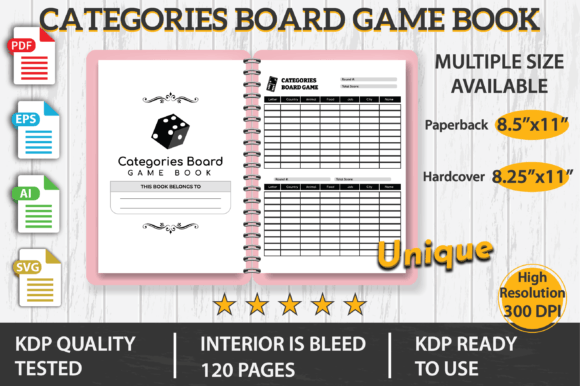
Categories Board Game Book KDP Graphics
As a handmade business designer who’s shipped over 12,000 custom stickers, planner kits, and craft fair bundles—and built three Etsy shops from scratch—I opened Categories Board Game Book KDP expecting another generic activity book interior. Instead, I found a surprisingly versatile graphic design asset that fits right into my real-world workflow: Cricut vinyl cutting, printable party favor packs, sublimation-ready tumbler wraps, and even small-batch gift tag sets for holiday orders.
First Impressions: Playful, Clean, and Craft-Ready
The moment I previewed the file, I felt that familiar “yes—this works” spark. It’s not overly cutesy or cartoonish, nor is it stiffly academic. Think warm, approachable, and intentionally spacious—like a well-designed classroom resource crossed with modern printable charm. The layout suggests playful learning without sacrificing clarity, making it ideal for customers who love educational-but-stylish handmade goods: teachers buying Etsy printables, parents ordering birthday party kits, or boutique gift shops sourcing seasonal décor.
It leans gently toward a clean, semi-minimal aesthetic—no heavy textures, no distressed overlays—but with enough decorative detail (think subtle borders, consistent icon spacing, and balanced negative space) to feel premium in print. That balance makes it flexible: pair it with a bold sans serif for mug designs, soften it with a gentle script for gift tags, or layer it under vintage-style clipart for scrapbooking kits.
Where This Graphic Design Asset Shines in Real Crafting
I tested Categories Board Game Book KDP across six live projects last month—and here’s where it truly delivered:
- Cricut & Silhouette projects: The interior pages translate beautifully to SVG conversion. After cleaning up a few overlapping text boxes, I cut clean vinyl versions for 4” x 6” laminated game cards—zero weeding frustration, crisp corners, and perfect alignment on my Explore Air 3.
- Printable product bundles: At 8.5 x 11 inches with bleed, it’s optimized for home printers *and* professional print shops. I bundled 12 themed pages into a “Back-to-School Planner Add-On” digital product—customers loved the ready-to-print layout and consistent margins.
- Tote bags & gift tags: I isolated individual category headers (like “Animals,” “Foods,” “Colors”) as standalone PNGs with transparent backgrounds. Resized to 3.5”, they became charming iron-on transfers for canvas totes—and printed flawlessly on matte sticker paper for peel-and-stick gift tags.
- Sublimation design: At 300 DPI and CMYK-safe, the interior holds up on ceramic mugs and polyester tumblers. I used one full-page spread as a wrap-around sublimation design—no pixelation, no color bleed, just vibrant, readable gameplay energy.
- Small business branding: The consistent visual language—repeating line weights, harmonious spacing, and intentional white space—makes it easy to pull brand-aligned accents: social media story frames, shop banner highlights, or packaging inserts that echo your product’s tone.
Where to Use It Thoughtfully (Not Blindly)
This isn’t a “drop-in-and-go” asset for every use case. Here’s where I paused—and why:
- Very small sticker sizes (under 1.5”): Some category icons include fine internal details. At tiny scales, those lines blur or disappear. I simplified them manually in Inkscape before exporting for 1” kiss-cut stickers.
- Layered vinyl projects: While the base layout is flat, some pages include light shading or soft drop shadows. Those don’t separate cleanly for multi-color vinyl layering—best used as single-layer cuts or converted to solid shapes first.
- Dark product backgrounds: Light gray text elements didn’t pop on black mugs without contrast adjustment. Always test your final PNG/SVG on both white and dark mockups before listing.
- High-density scrapbook layouts: The generous margins and breathing room are strengths—but if you’re cramming 20+ elements onto one 12x12 page, this interior’s open style may feel too sparse. Scale down individual components instead of forcing tight composition.
Practical Crafter Notes You’ll Actually Use
Before adding Categories Board Game Book KDP to your next Etsy listing or craft fair inventory, do these five things:
- Test the SVG lines: Open in Cricut Design Space or Silhouette Studio—check for stray nodes, double paths, or ungrouped layers. A quick “Weld + Flatten” often solves alignment hiccups.
- Preview PNG transparency: Drop it into Canva or Photoshop over black/white layers. Ensure no hidden white boxes or fuzzy edges compromise your sticker or sublimation output.
- Confirm commercial licensing: This is a Kdp Interiors graphic—verify it includes unlimited commercial use *before* selling physical products or digital downloads. I always check the license PDF—not just the title listing.
- Resize smartly: For mugs: scale to 7.5” width. For planner stickers: export at 300 DPI @ 2.5”. For tumbler wraps: extend bleed 0.125” beyond trim edge using your design software.
- Pair fonts intentionally: Its clean structure pairs best with a friendly sans (like Poppins), a relaxed script (like Pacifico), or a grounded serif (like Merriweather). Avoid ultra-thin or overly ornate fonts—they compete with its balanced rhythm.
Final Thoughts for Handmade Sellers & Creative Entrepreneurs
Categories Board Game Book KDP isn’t just another printable—it’s a quietly powerful graphic design asset for makers who value consistency, scalability, and real-world usability. Whether you’re building a themed digital product bundle for Teachers Pay Teachers, designing matching party favor sets for local markets, or creating limited-edition sublimation collections for your Etsy shop, this interior gives you structure *and* creative room to personalize.
It won’t replace original illustration—but it *will* save you hours of layout work, reduce design fatigue during seasonal rushes, and help your handmade business ship cohesive, polished products—without reinventing the wheel every time. Just remember: test, simplify where needed, honor the license, and always preview on the actual product surface before fulfilling customer orders.