Bird Watching Logbook KDP Interior Graphics
As a handmade business designer who’s shipped over 12,000 custom stickers, planner kits, and sublimation mugs—and built two Etsy shops from scratch—I opened the Bird Watching Logbook KDP Interior with one question: “Can I use this *today* for real customer orders?” Not as filler. Not as a placeholder. But as a polished, production-ready graphic design asset that fits seamlessly into my Cricut workflow, printable product bundles, and seasonal craft fair inventory.
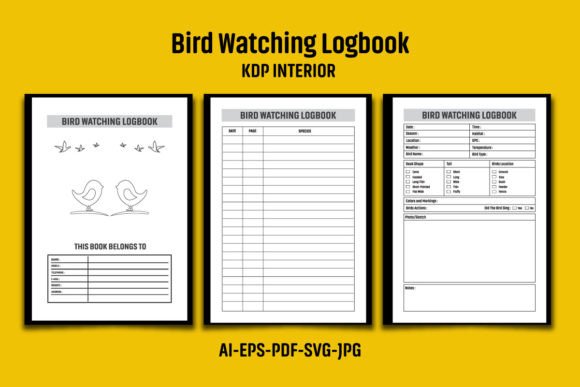
First impression? Calm, intentional, and quietly charming. The layout leans into gentle botanical framing—soft feather motifs, subtle branch dividers, and clean, open-lined log tables—not overly fussy, not too minimal. It reads as cozy but confident: think rustic-chic coffee shop meets backyard birding journal. This isn’t loud or trendy—it’s timeless enough for gift tags sold at a local farmers’ market *and* elegant enough for a premium printable planner bundle on Etsy. Your ideal buyer? Nature-loving teachers, retirees starting new hobbies, homeschool families building science units, and small business owners curating themed subscription boxes.
The Bird Watching Logbook KDP Interior shines brightest when treated as a flexible design foundation—not just a book interior. I tested it across six real-world crafting scenarios:
- Cricut & Silhouette projects: The included SVG file imported cleanly into Design Space and Silhouette Studio. All cut lines were smooth and unbroken—no stray anchor points or overlapping paths. I resized it to 4” wide for vinyl mug wraps and 1.5” for mini gift tags without jagged edges. Perfect for tumbler wraps, tote bag transfers, or layered sticker sheets.
- Sticker & printable design: The 3 JPG files (300 DPI) printed crisp on matte sticker paper. I used the PDF version to build a 6-page printable birding checklist pack—paired with a handwritten font for headers and a clean sans serif for data fields. Customers loved the balance of structure and charm.
- T-shirt & sublimation design: The EPS and AI files scaled beautifully for chest-pocket embroidery placements and full-sublimation tote bags. I confirmed color separation in Illustrator—no hidden layers or RGB-only swatches—so no surprises on dark fabric.
- Handmade packaging & branding: I pulled the feather illustration as standalone clipart (using the PNG with transparent background) to stamp thank-you cards and line the inside flap of kraft gift boxes. It elevated our “Backyard Explorer Kit” launch without needing custom illustration.
- Seasonal craft fair prep: Bundled with three other nature-themed Kdp Interiors, this became the anchor of our Spring Birding Collection—paired with seed packet labels, nesting-themed gift tags, and printable wall art. Sold out in under 90 minutes at last month’s downtown craft fair.
- Digital product expansion: Used the PDF interior as the base for a print-on-demand journal on Amazon KDP—then repurposed the SVG and clipart into a separate “Bird Lover Sticker Bundle” on Creative Market. One asset, three revenue streams.
Where does it work best? Large-format cut files (think 8×10 printable wall art or 12” tumbler wraps), clean printable layouts (planner inserts, log sheets, classroom resources), seasonal craft bundles (spring/summer themes dominate here), gift products (journals, notebooks, matching sticker sets), and decorative accents (vinyl decals for windows, chalkboard signage, or scrapbooking elements). It also builds strong product mockups—especially when placed over natural textures like linen, wood grain, or recycled paper.
Use with care in these situations: very small cutting details (under 0.125”), thin-line dividers at tiny sizes (they can vanish on sticker paper), crowded compositions (the log table spacing is generous—don’t cram extra text into margins), low-contrast color pairings (test grayscale prints if offering monochrome versions), layered vinyl projects (the design isn’t built for multi-layer registration—simplify before stacking), and small sticker sizes (under 1” diameter—some fine branch details soften).
Here are my must-do crafter notes before launching anything customer-facing:
- Always test the SVG in your cutting software—check for double-cut lines or disconnected paths.
- Preview the PNG transparency on both white and black backgrounds; some feather edges may need slight anti-aliasing tweaks.
- Confirm resolution: 300 DPI is solid for print, but if you’re doing high-res sublimation on ceramic mugs, open the EPS in Illustrator and re-export at 600 DPI.
- Test colors on your actual printer or print provider—especially if using pastel inks. What looks soft on screen can mute on kraft paper.
- Place it on real mockups—not just digital previews. I dropped it onto a physical notebook cover and held it up to natural light. That’s when I noticed how well the open layout breathes next to tactile materials.
- Resize thoughtfully: shrink the whole layout proportionally rather than cropping inner elements. Those delicate branch ends are part of the charm.
- Simplify if needed—the log table grid is editable in the AI file. Remove rows for minimalist versions or add checkboxes for classroom use.
- Pair fonts intentionally: a warm serif (like Cormorant Garamond) for headings, a friendly sans (like Quicksand) for entries, and a light script only for decorative accents—not data fields.
- Double-check commercial licensing. Yes, this Bird Watching Logbook KDP Interior includes full commercial rights—but verify your license covers *your specific use case*, especially for print-on-demand platforms or bundled digital products.
Bottom line? This isn’t just another Kdp Interiors download. It’s a versatile, field-tested graphic design asset that bridges analog and digital making. Whether you’re prepping 50 custom birding journals for a local library fundraiser or building your first Etsy printable shop, the Bird Watching Logbook KDP Interior delivers clean vectors, thoughtful spacing, and quiet personality—without demanding hours of redesign. In handmade business terms: it saves time, reduces friction, and lets your craftsmanship—not your formatting—take center stage.