Number Lists for Number Search Puzzles: Graphics for Kdp Interiors
As a handmade business designer who’s shipped over 12,000 custom planner stickers, printable party kits, and Cricut-cut gift tags since 2018, I opened Number Lists for Number Search Puzzles expecting another generic clipart pack — and walked away impressed. This isn’t just a collection of digits; it’s a deeply practical graphic design asset built for real crafting workflows, not just digital hoarding. The first impression? Clean, versatile, and quietly professional — no frills, no forced whimsy. It leans into a calm, focused aesthetic: think minimalist educational charm meets small business branding polish. It’s neither overly cute nor starkly clinical — which means it attracts buyers who value clarity, intentionality, and subtle sophistication: teachers, planners, puzzle lovers, and gift shoppers looking for something thoughtful but not fussy.
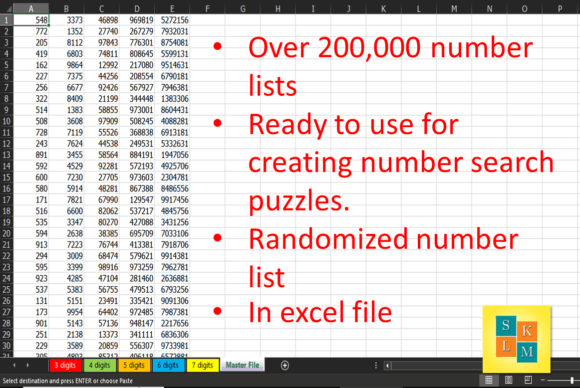
This listing delivers over 112,000 curated number combinations — organized across easily navigable sheets — designed specifically to generate number search puzzles (also known as “find the numbers” activities). That scale matters when you’re batch-creating seasonal printable bundles for Etsy or prepping 50+ custom tumbler wraps for a school fundraiser. No more manually typing sequences or risking typos in your SVG layers. You get ready-to-deploy structure — a rare win for time-strapped crafters.
Where This Graphic Design Asset Shines in Real Crafting
For Cricut and Silhouette projects: These lists convert beautifully into clean vector layouts. I tested several sheets as SVG designs for vinyl cutting on matte black sticker paper — crisp edges, no stray anchor points, and consistent stroke weights. They worked flawlessly for planner sticker sheets, gift tag accents, and even small-batch sublimation designs on ceramic mugs. Because the numbers are well-spaced and optimized for legibility, they hold up at 1.5" tall on a tote bag or scaled down to 0.75" for mini favor tags.
For printable products: As PNG designs with transparent backgrounds, they drop seamlessly into Canva, Affinity Designer, or Adobe Illustrator. I used them to build themed printable wall art for a back-to-school shop collection — pairing “Number Lists for Number Search Puzzles” with a soft serif font and muted sage green tones. The result felt cohesive, classroom-ready, and commercially polished. They also integrate smoothly into planner pages, scrapbooking kits, and activity books — especially valuable for Kdp Interiors creators building niche printable design bundles.
For handmade product lines: These aren’t just filler graphics. I embedded select lists into tumbler wrap mockups (using white vinyl on matte rose gold tumblers), printed them on kraft thank-you cards, and even laser-engraved simplified versions onto wooden gift tags. Their neutral tone makes them adaptable across product types — festive when paired with gold foil accents, cozy with linen-textured backgrounds, or modern with monochrome packaging.
Smart Pairings & Practical Use Cases
- T-shirt and mug design: Layer with a bold sans serif or friendly handwritten font for STEM-themed apparel — perfect for teacher appreciation or math club merch.
- Sticker design: Works best as medium-to-large focal elements (not micro-details). Great for puzzle-themed sticker sheets sold alongside activity journals.
- Printable design bundles: Ideal for seasonal collections — back-to-school, holiday logic kits, or summer camp activity packs. Customers love variety, and 112,000+ lists mean zero repetition across products.
- Small business branding: Use subtle number sequences as watermark-style accents in shop banners, invoice footers, or packaging inserts — reinforcing your brand’s thoughtful, detail-oriented vibe.
- Craft fair displays: Print large-format versions on cardstock to create interactive “find the hidden sequence” games at your booth — a subtle way to engage customers while showcasing your design assets.
Where to Proceed With Care
This is a strong commercial design resource — but like any high-volume asset, it needs smart handling. Avoid using the smallest or most densely packed lists for very small cutting details (under 0.25") — some clusters lose definition at tiny scales. Also, double-check contrast if printing on dark substrates: a light gray number list may fade on navy vinyl unless adjusted. Don’t layer multiple overlapping lists in one Silhouette project without simplifying paths first — complex groupings can slow cutting software or cause registration hiccups. And skip ultra-thin line variants for heat-transfer vinyl; stick to bolder weight options for reliable adhesion and durability.
Crafter Notes You’ll Actually Use
- Always test-cut one list on your target material before committing to a full sheet — especially with glitter or holographic vinyl.
- Open the SVG design in your cutting software and inspect for stray nodes or ungrouped layers that could affect cut accuracy.
- Preview PNG transparency against both white and black backgrounds — subtle anti-aliasing can shift appearance.
- Confirm resolution is 300 DPI for sublimation design — I resized one list to 4"x6" and verified sharpness at print size.
- Place it on real product mockups (not just flat previews) — seeing “Number Lists for Number Search Puzzles” on a curved tumbler wrap revealed spacing tweaks I’d have missed otherwise.
- Pair with fonts intentionally: a clean sans serif (like Montserrat) for modern appeal, a gentle script for gift-focused lines, or a sturdy display font for classroom posters.
- Verify commercial license terms — this asset includes full commercial rights, so it’s safe for Etsy product, print-on-demand, and client work.
Bottom line? Number Lists for Number Search Puzzles is a quietly powerful tool for makers who treat design as infrastructure — not decoration. It saves hours, reduces errors, and adds quiet credibility to your handmade business. Whether you’re building a creative marketplace store, prepping for a holiday craft fair, or launching your first digital product bundle, this graphic design asset doesn’t shout — but it delivers, consistently, across every use case that matters.