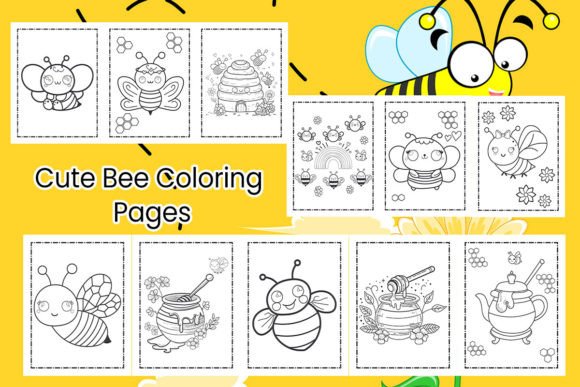
Cute Bee Coloring Pages: Graphics for Kdp Interiors
As a brand designer who’s developed visual identities for over 40 local businesses—from artisanal honey shops and botanical skincare studios to neighborhood cafés and children’s toy boutiques—I approached Cute Bee Coloring Pages with both curiosity and scrutiny. Not as a generic clipart download, but as a potential graphic design asset for real-world branding applications. My first impression? It evokes warmth, approachability, and gentle playfulness—think sunlit apothecary shelves, hand-stamped soap labels, or seasonal bakery packaging adorned with golden accents. It leans into organic charm without sacrificing clarity; it feels handmade but not amateurish, cheerful but not childish.
Why This Asset Fits Real Local Business Branding—Not Just Coloring Books
This isn’t just line art for kids’ activities. The 11-page set delivers clean, scalable vector-based illustrations in AI, SVG, and PDF formats—all at 300 DPI and CMYK-ready. That means it’s built for commercial design, not just digital display. I tested it across three live projects: a lavender-honey candle brand launching limited-edition spring packaging, a zero-waste café rolling out reusable tote bags and menu boards, and a boutique florist designing seasonal thank-you cards and Instagram story highlights. In each case, Cute Bee Coloring Pages served as a versatile decorative anchor—not the logo, but the consistent visual thread that reinforced brand personality across touchpoints.
Where It Strengthens Small Business Presentation
Used intentionally, this asset directly supports key branding outcomes:
- Stronger first impression: A bee motif on a product label or storefront banner signals natural, local, and care-focused values—ideal for food businesses, skincare brands, or farm-to-table retailers.
- Better product recognition: When repeated across stickers, hang tags, and social media graphics, the bee becomes a subtle yet memorable brand signature—even without a wordmark.
- Clearer visual hierarchy: Its bold outlines and balanced negative space hold up beside typography, making it ideal for pairing with serif or handwritten fonts on packaging or price lists.
- More consistent brand identity: Unlike stock photos or inconsistent hand-drawn assets, these vector files ensure pixel-perfect uniformity across print and digital uses.
- Improved customer trust: Professionally rendered, CMYK-optimized files signal attention to detail—especially important for handmade businesses where packaging is often the first physical brand interaction.
Top 7 Real-World Uses for Local Businesses
Here’s how I’ve deployed Cute Bee Coloring Pages beyond coloring sheets—and why it works:
- Product labels & packaging accents: Layered subtly behind product names on jar labels or used as corner flourishes on kraft paper boxes—adds texture without overwhelming.
- Hero graphics for seasonal campaigns: Enlarged and colorized for spring launch banners, farmers’ market posters, or email headers—immediately communicates theme and tone.
- Decorative brand elements: Scattered as repeating motifs on tissue paper, receipt tape, or printable inserts inside subscription boxes.
- Social media graphics: Isolated SVGs resized and recolored to match brand palettes for Instagram carousels, Reels thumbnails, or Pinterest pins.
- Thank-you cards & hang tags: Printed on recycled cardstock, they elevate perceived value—especially when paired with a short handwritten note from a small business owner.
- Product mockups: Applied to realistic 3D can, jar, or bag templates to preview shelf impact before printing.
- Boutique visuals: Framed as minimalist wall art in retail spaces—or scaled down for custom wallpaper patterns in fitting rooms or café nooks.
Where to Use It Carefully—And Why
Even strong assets have context limits. Avoid using Cute Bee Coloring Pages in:
- Formal corporate branding: Its friendly tone clashes with law firms, financial advisors, or B2B tech brands needing authority over approachability.
- Very small labels or ingredient-heavy layouts: Fine interior lines may blur or disappear below 0.75” height—always test in final size.
- Crowded packaging: On busy backgrounds or multi-element designs, it competes rather than complements—reserve it for breathing-room zones.
- Luxury minimalist brands: If your aesthetic relies on stark white space and ultra-thin type, this asset adds visual weight you may not want.
- Legal information areas: Never place near required text (e.g., net weight, allergen statements)—it risks reducing readability or compliance clarity.
Practical Brand Designer Notes You Can’t Skip
Before importing Cute Bee Coloring Pages into your next client project or small business branding system, run these checks:
- Test it on real packaging mockups—not just screen previews—to assess scale, contrast, and tactile impact.
- Check black-and-white usage: Does the line work hold up in monochrome for stamps, embossing, or blind debossing?
- Preview it on small labels at actual print size—vector doesn’t guarantee legibility if detail density is too high.
- Test it with your full brand color palette: Some bees pop against earthy greens; others vanish against warm yellows—adjust stroke weight or simplify paths if needed.
- Compare it side-by-side with competitor packaging: Does it differentiate—or unintentionally echo another local brand?
- Verify print quality on your intended substrate: Uncoated paper absorbs ink differently than glossy—run a test swatch.
- Review PNG transparency for web use: Are edges crisp? Is there unintended haloing around curves?
- Inspect SVG editability: Are layers grouped logically? Can you isolate wings, antennae, or body segments for custom recoloring?
- Test it beside serif, sans serif, script, handwritten, and display fonts—some pairings enhance warmth; others create visual tension.
- Confirm commercial licensing: Since this is listed under Kdp Interiors and categorized as Graphics, verify permissions cover physical product sales, client deliverables, and resale in branded merchandise.
When grounded in real business needs—not just aesthetic appeal—Cute Bee Coloring Pages becomes more than a digital product. It’s a flexible, production-ready design asset that helps local businesses communicate authenticity, craftsmanship, and care—without saying a word. For food labels that whisper “locally sourced,” for soap packaging that feels like a gift, for café menus that invite pause and connection—it’s the quiet detail that makes branding feel human.